Back to School Admission Flyer Design: A Practical Guide for Schools, Creators, and Business Owners
When the back-to-school season approaches, educational institutions and design professionals face a familiar challenge: creating compelling admission materials that capture attention and convey essential information. A well-crafted Back to School Admission Flyer Design does more than announce enrollment dates—it sets the tone for the entire academic year. Whether you are a school administrator preparing a recruitment campaign, a freelance graphic designer serving multiple clients, or a business owner marketing educational programs, understanding what makes a flyer effective can save you time, money, and frustration.
This article explores the practical aspects of Back to School Admission Flyer Design, examining its features, real-world applications, and what you can realistically expect when working with customizable templates. Rather than a promotional pitch, consider this a field guide based on common experiences and practical needs.
What Makes a Back to School Admission Flyer Design Effective?
At its core, an admission flyer must do three things: inform, persuade, and direct. Inform prospective families about dates, requirements, and contact details. Persuade them that your institution offers something valuable. Direct them toward a clear next step, whether that is visiting a website, attending an open house, or submitting an application.
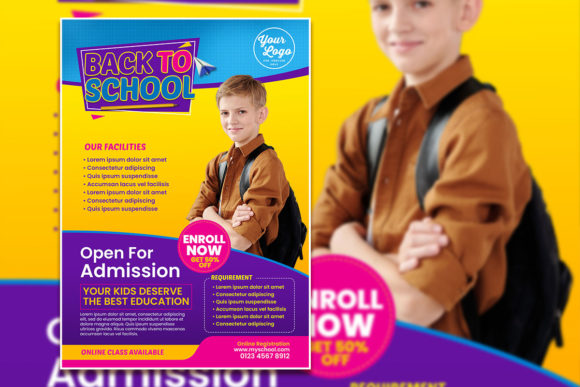
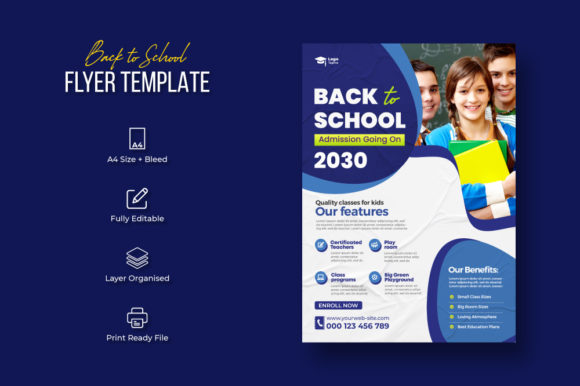
A thoughtfully prepared Back to School Admission Flyer Design achieves these goals through visual hierarchy, clear typography, and consistent branding. Colors, fonts, and imagery work together to create an emotional connection—warmth, trust, and excitement for the learning journey ahead. When you work with a flyer template that is fully customizable and editable, you retain control over every element, from the headline placement to the call-to-action button.
One key advantage of using a dedicated design file, such as the PSD Adobe Photoshop format mentioned in many professional templates, is that you can adjust colors, swap text, and rearrange layout modules without starting from scratch. This is especially valuable during peak admission periods when multiple flyer versions are needed for different grade levels, programs, or events.
Key Features of Professional Back to School Admission Flyer Templates
Understanding the features of a Back to School Admission Flyer Design helps you evaluate whether a template meets your project requirements. Below are the most common features found in well-structured flyer templates, along with practical explanations of why each matters.
Fully Customizable and Editable Layers
A professional flyer template arrives with layers that are organized and named. This means you can locate the background layer, text layer, image placeholder, and decorative elements quickly. Instead of hunting through unlabeled groups, you open the Layers panel in Adobe Photoshop and see logical names like "Headline," "School Logo," "Admission Details," and "Call to Action." Editing becomes a matter of double-clicking a smart object or selecting a text layer and typing your content. For a school administrator with basic Photoshop skills, this reduces production time from hours to minutes. For a professional designer, it allows rapid iteration when a client requests changes.
Print Ready with Bleed and 300 DPI CMYK Color Mode
Print readiness is one of those features that distinguishes a usable template from a mere digital layout. A Back to School Admission Flyer Design that is print ready includes bleed—typically 3 mm or 0.125 inches on each side—so that when the flyer is trimmed, no unprinted edges appear. The 300 DPI resolution ensures crisp text and sharp images when printed on standard offset or digital presses. CMYK color mode, rather than RGB, guarantees that the colors you see on screen closely match the printed output. If you have ever printed a flyer only to find washed-out colors or white borders, you understand why these specifications are non-negotiable for professional results.
Smart Object Image Placeholders
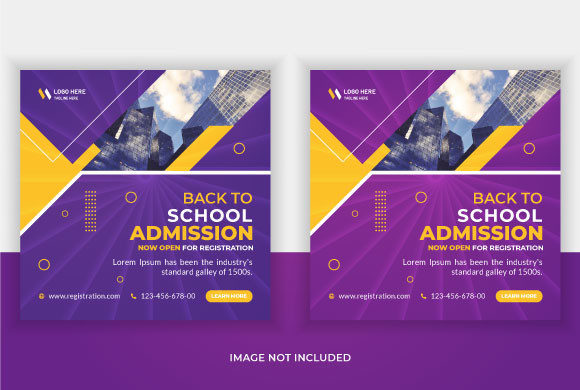
Most high-quality flyer templates use smart objects for image insertion. A smart object is a layer that contains an embedded image file. When you double-click the smart object thumbnail, Photoshop opens a separate document where you place your photo. After saving, the image appears in the flyer with any effects, masks, or adjustments applied automatically. This is especially useful when you need to add student photos, campus images, or activity pictures. The effects—shadows, overlays, gradients, or color grades—remain intact, so your replacement image integrates seamlessly. It is worth noting that professional templates typically state that images are not included in the download package, which is standard practice to avoid licensing issues. You supply your own photos, and the smart object system does the rest.
Free Fonts Used and Proper Licensing
Templates often specify that free fonts are used, meaning you can download the exact typefaces from sources like Google Fonts or other open-source repositories without additional cost. This is a practical consideration for budget-conscious schools and freelance designers. When a template uses free fonts, you can replicate the exact look of the preview design. If custom or premium fonts were required, you would need to purchase licenses. Always check the font list before committing to a template so you know what to download.
Where and How to Use a Back to School Admission Flyer Design
The versatility of a well-designed flyer extends beyond the school newsletter. Here are several real-world scenarios where a Back to School Admission Flyer Design proves valuable:
- Open house events and campus tours: Printed flyers placed at information desks, pinned on bulletin boards, or handed to visiting families create a tangible reminder of your institution.
- Digital distribution via email and social media: Save the flyer as a high-resolution JPEG or PDF and share it through mailing lists, school Facebook groups, or Instagram posts. The print-ready layout also translates well to on-screen viewing when exported properly.
- Local community boards and libraries: Physical flyers posted in community centers, coffee shops, and public libraries reach families who may not be actively searching online.
- Partnership with local businesses: Ask nearby businesses to display your flyer at their checkout counters. Daycare centers, children's clothing stores, and family restaurants are common partners.
- Direct mail campaigns: For targeted outreach, print flyers and mail them to households within a specific radius of the school.
Each of these use cases benefits from a design that is both visually appealing and practical. A cluttered flyer with too much text will be ignored in a busy environment. A design that uses clear sections, bold headlines, and ample white space performs better across all formats.
Who Benefits from Using a Professional Flyer Template?
While anyone can create a basic flyer using word processing software, the results often lack the polish needed to inspire confidence in a school or program. The following groups gain the most from a dedicated Back to School Admission Flyer Design template:
- School administrators and marketing coordinators who need to produce multiple flyers each season without hiring an external designer for every iteration.
- Freelance graphic designers who work with education clients and want a reliable starting point that they can customize per school brand guidelines.
- Preschool and daycare owners who operate on tight budgets and need professional marketing materials without the cost of custom design.
- Tutoring centers, after-school programs, and summer camps that compete with schools for attention during enrollment periods.
- PTA and parent volunteers who coordinate school events and need a consistent visual identity across communications.
For each of these users, the value lies in the balance between customization and convenience. You are not forced to accept a one-size-fits-all layout. Instead, you inherit a structure that has been designed with print standards, visual hierarchy, and user experience in mind.
Practical Considerations and Limitations
No template is perfect for every situation. Being aware of the limitations helps you make informed decisions when selecting a Back to School Admission Flyer Design.
Images are not included. As mentioned earlier, this is standard practice. The download package contains the PSD file and font links, but you must supply your own photographs. If you do not have access to high-quality school photos, consider using stock photography or scheduling a photo day specifically for marketing materials.
You need Adobe Photoshop. The PSD format is native to Photoshop. If you do not have access to this software, you cannot directly edit the layers and smart objects. However, many designers and schools already have Creative Cloud subscriptions, and the investment is often justified by the volume of materials produced.
Free fonts require manual installation. While the fonts themselves are free, you need to download and install them before the template renders correctly. This is a simple process but can be a stumbling block for users unfamiliar with font management.
Smart objects are powerful but require basic knowledge. If you have never used smart objects in Photoshop, there is a small learning curve. However, once you understand the concept—double-click to edit, save, and close—it becomes an efficient workflow. Many template sellers include video or PDF instructions to guide you.
How to Evaluate a Flyer Template for Your Needs
Before you commit to a specific Back to School Admission Flyer Design, ask yourself these questions:
- Does the layout match your content volume? If you have a long list of admission requirements, choose a flyer with enough text space. If your message is short, a minimalist design works better.
- Are the color schemes adjustable? Even if the preview shows blue and green, you should be able to change the color palette to match your school branding.
- Is the file resolution adequate for your printer? Confirm that the template is 300 DPI and uses CMYK. Some digital-first templates use RGB and lower resolution, which leads to poor print results.
- What format is the flyer size? Standard sizes like A5, A4, US Letter, or 8.5x11 inches are widely supported by printers. Custom sizes may incur additional costs.
- Are there multiple versions included? Some templates come in both portrait and landscape orientations, or include a matching social media graphic—this can be a time-saving bonus.
By evaluating these factors, you avoid the frustration of downloading a template that looks great in the preview but fails to meet your practical requirements.
Final Thoughts on Back to School Admission Flyer Design
Creating an effective admission flyer does not require a decade of design experience. It requires the right tools, a clear understanding of your message, and a template that handles the technical heavy lifting. A well-structured Back to School Admission Flyer Design with organized layers, print-ready specifications, smart objects, and free fonts provides a solid foundation for both print and digital use.
Whether you are announcing kindergarten registration, promoting a magnet program, or recruiting for extracurricular activities, the flyer you present reflects the quality and care of your institution. By choosing a customizable template that aligns with your brand, you save time, reduce stress, and produce materials that stand out during the busy back-to-school season.
Remember that the greatest strength of a professional template is not the design itself—it is the flexibility it gives you to adapt that design to your unique story. Add your own images, write your own headlines, and adjust colors until the flyer feels like yours. The template is the scaffold; your content is what gives it meaning.